
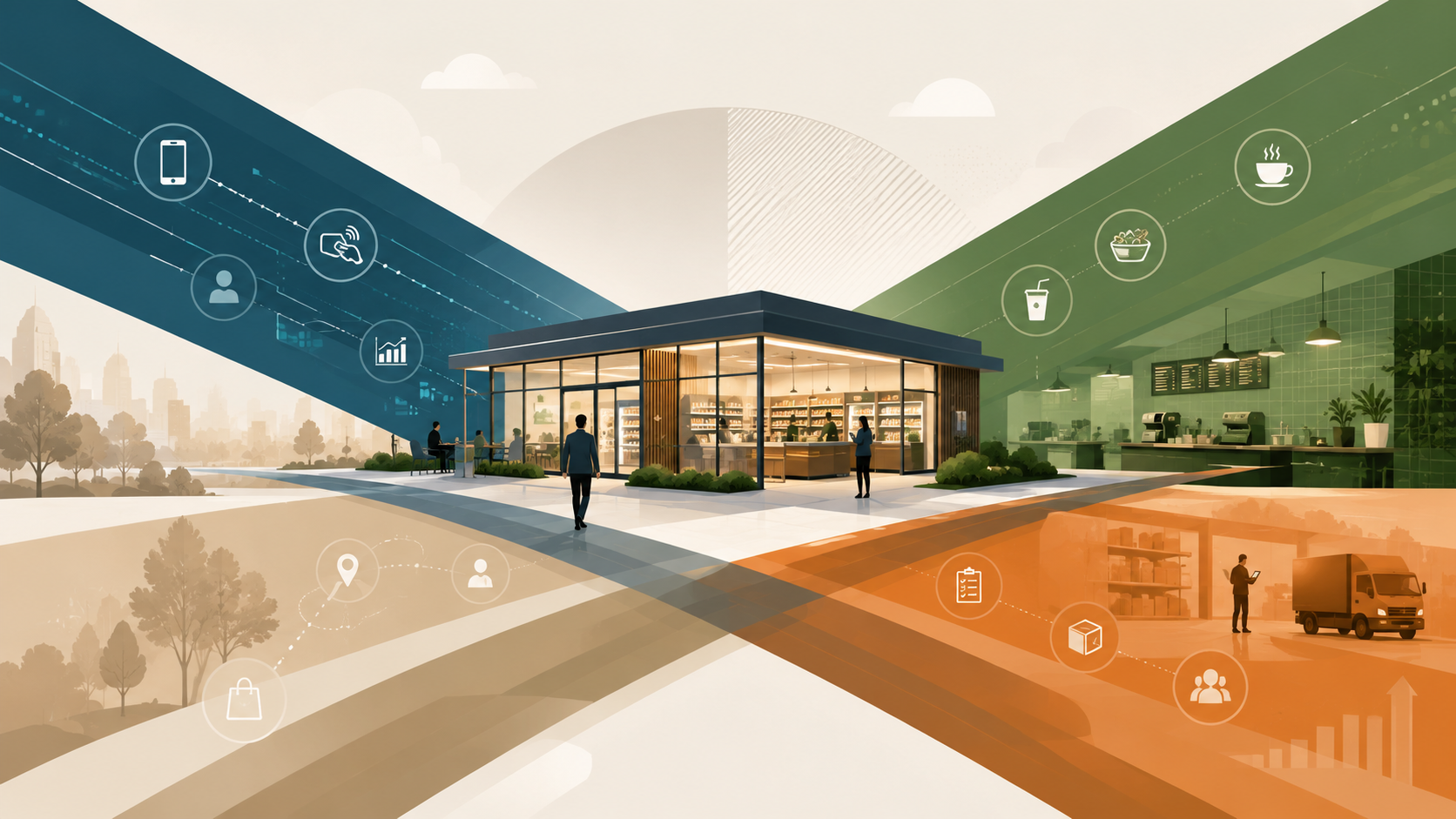
Ahead of CStore Momentum, one thing is clear from the agenda: the industry’s biggest priorities are no longer separate conversations.
Technology, foodservice, loyalty, operations, culture and leadership increasingly depend on one another. A new digital tool changes how customers move through the store, a stronger food program changes the layout, labor model and reason for visiting and a new brand promise only matters if employees can deliver it consistently.
That intersection is where the next generation of convenience retail will be built.
Technology must improve the whole experience
Convenience retailers have more technology available than ever, from loyalty platforms and retail media to mobile ordering, delivery and operational analytics. But technology creates less value when it is added as a disconnected layer.
Order-ahead affects pickup placement, queueing and handoff, loyalty influences the messages customers see throughout the journey and retail media changes how screens, fixtures and in-store communication work together. The question should not simply be, “What technology should we introduce?” It should be: How should the experience change now that this technology exists?
The physical store is where digital promises are either fulfilled or broken. The strongest technology investments will be designed alongside the customer journey and operating model, not added afterward.
Foodservice is becoming the organizing idea
Foodservice is now central to how many convenience retailers compete and grow. That shift has major implications for store design.
It’s difficult to create a credible food destination when food is treated as another category placed wherever space remains. A strong program must be visible, intuitive and supported by the full environment.
Retailers need to consider what customers see on entry, how freshness is communicated, where ordering and pickup happen, how dayparts are presented and whether the layout supports employees during peak demand.
For many operators, the next prototype may need to begin with foodservice rather than asking how foodservice fits into a predetermined box.
Operational intelligence should shape design
Good retail design is not simply visual. It determines how far employees walk, whether queues block destinations, how quickly products can be replenished and how easily customers understand the store.
These details influence labor, throughput, consistency and customer perception. Too often, strategy is developed first, design follows and operations are asked to make the result work. A better process brings operators, foodservice leaders, merchandisers, technology teams and designers together early. The result is not only a better-looking store - it’s a store that works harder.
Change succeeds through people
Every transformation creates a new employee experience alongside a new customer experience. A redesigned food program introduces new routines, a technology platform changes responsibilities, and a prototype may look compelling in a presentation but feel unnecessarily complicated during a morning rush.
Employees should be involved early - their frontline knowledge often reveals friction that leaders, consultants and designers cannot see from a conference room.
The store is where every strategy meets
Customers do not experience departments, they experience whether the visit feels easy, relevant and worth repeating.
The future of convenience retail will not be defined by one new format, platform or menu. It will be defined by how intelligently retailers bring technology, foodservice, operations, design and culture together into one coherent experience.
Where BDL Partners sits on all this
At BDL Partners, we've spent thirty-plus years designing convenience and forecourt retail across the globe, and our view is straightforward: design is a commercial system, not a decorative one. Every material, sightline, lighting choice and layout decision either earns its place against a business outcome or it doesn't. We work from the corporate brief and we bring a design team with the depth of experience to translate that brief into stores that perform - commercially and experientially. Technology, foodservice ambition and brand strategy all have to land somewhere and that somewhere is the physical store.
We also believe the category is past the point of incremental thinking. Foodvenience isn't a growth lever anymore, it's the competitive floor. Technology amplifies what's already there, which means the fundamentals have to come first. And the operators who move with clarity and conviction now will define the next decade. The ones who wait will be remodelling in crisis mode.